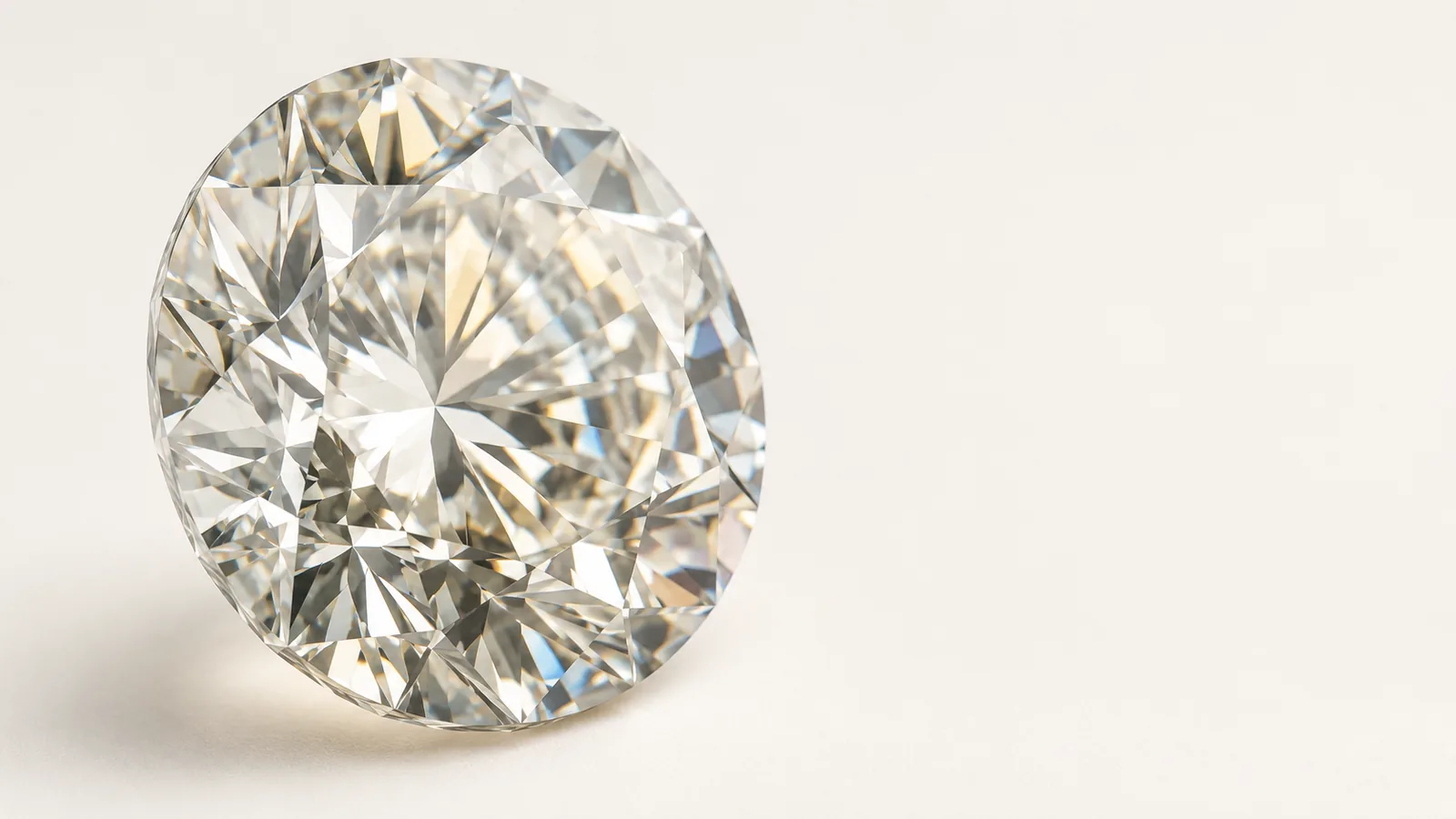
Most web configurators fake a diamond with a reflection map or a generic glass material. Ring Facet ray-traces the real facet geometry of the stone in your CAD file, in a browser tab, on a phone.
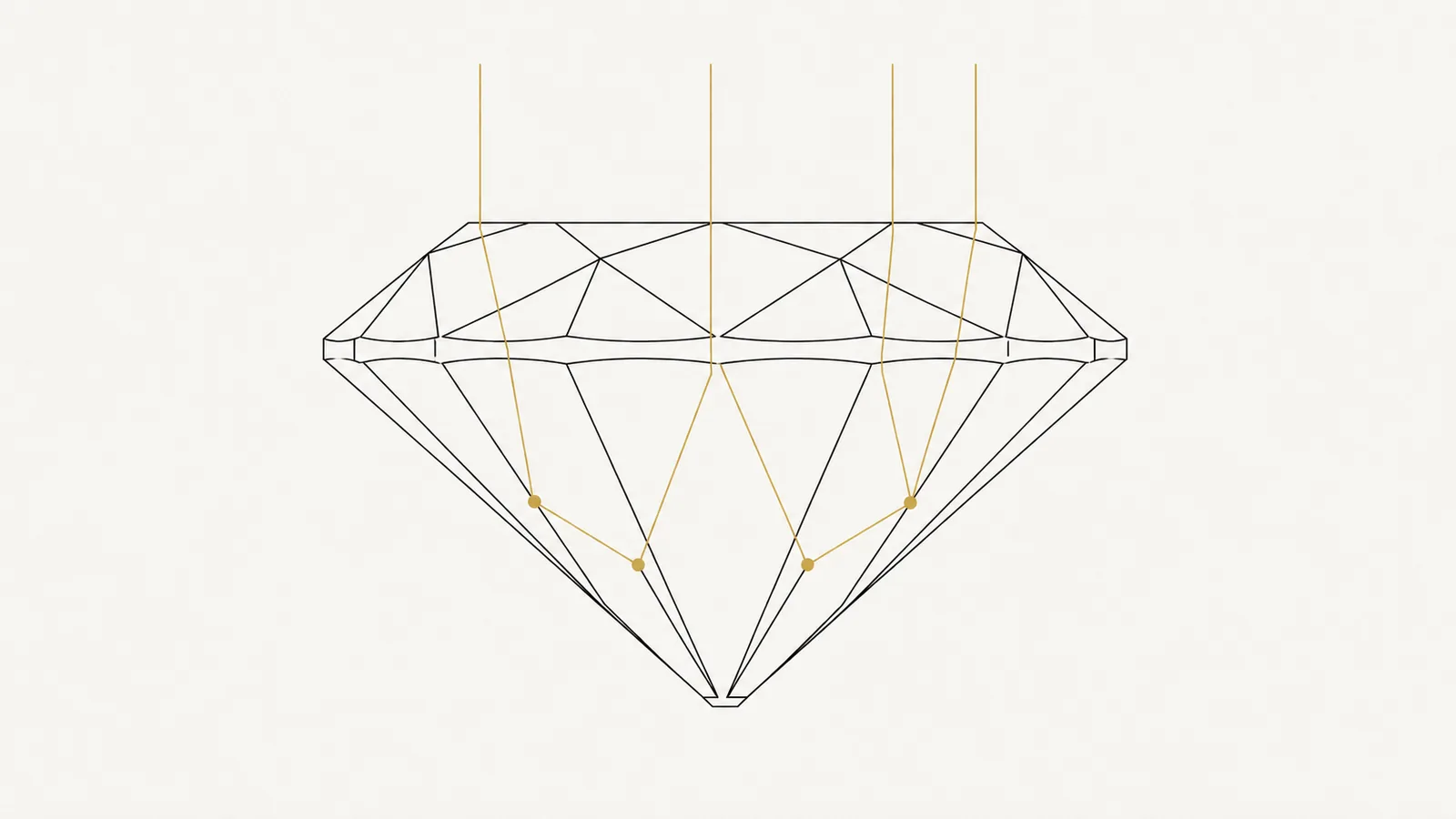
What makes a diamond read as a diamond is total internal reflection between flat facets — light entering the table, bouncing several times off the pavilion, and leaving through the crown split into colour. A cube map cannot do that: it samples the environment once and stops. A standard transmission material does refraction, but against a triangle mesh, which is slow and noisy on the melee stones that make up a pavé halo.
The approach
Fit the facets, then trace them analytically
At load time the engine reads the stone out of the model file and fits its facets as a set of half-space planes — the mathematical description of a cut. The shader then traces rays against that convex solid directly. There is no baked data, no per-stone authoring step, and no shader recompile: a cut the engine has never seen before works the first time it is loaded, which is what makes uploading your own CAD viable at all.
The coverage
95% of stones render analytically
Measured across the entire shipping catalogue — 39 model files, 364 individual stones — 95% fit cleanly enough to trace analytically. The remaining 5% are genuinely non-convex centre stones in the pear, heart, and marquise cuts, which fall back to a bounding-volume-hierarchy tracer automatically. The fit is tight: on melee stones the convexity error is around two parts in a thousand of the stone's radius.
The hard part
Pavé is one mesh until you take it apart
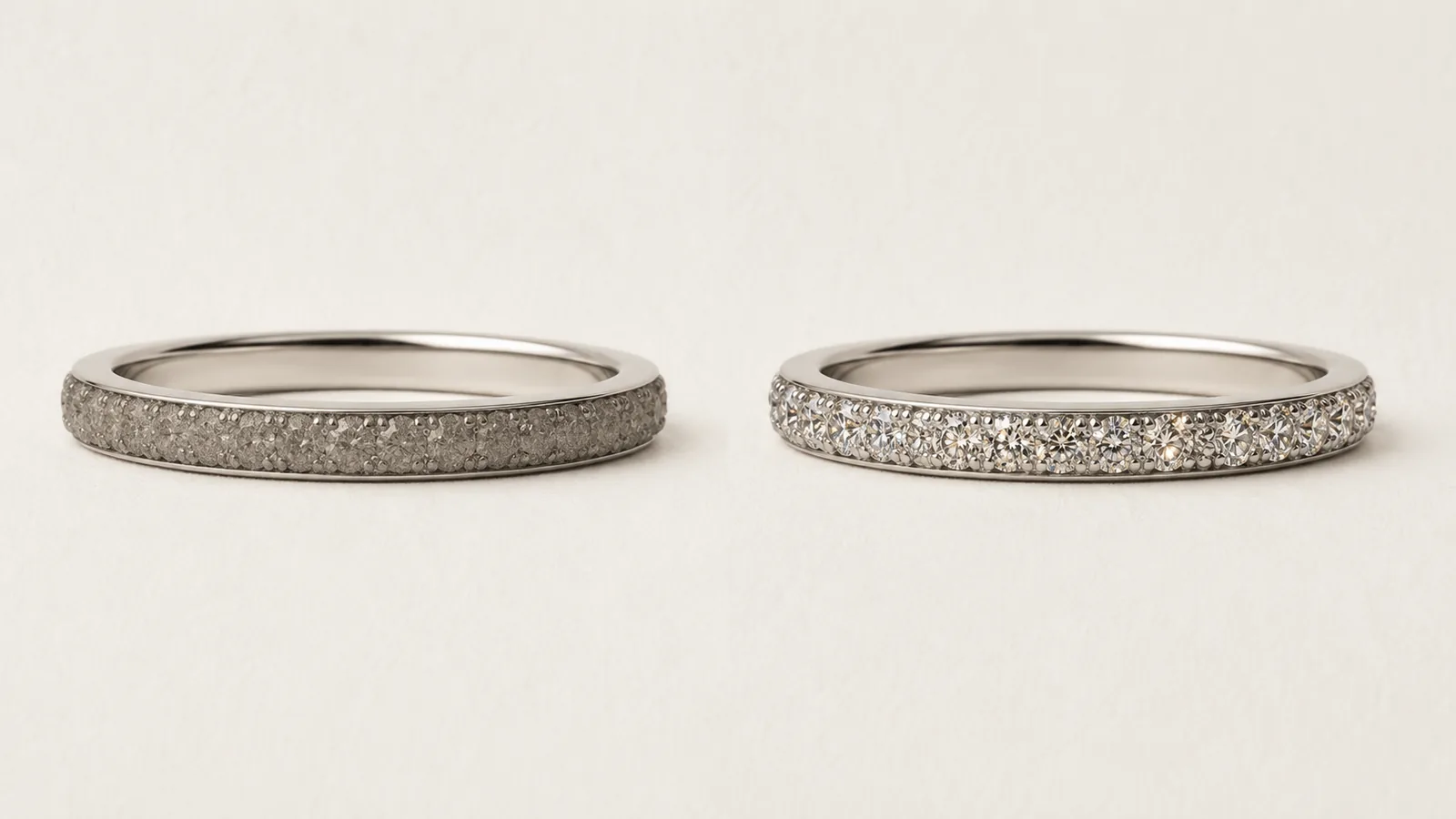
Exporters merge every melee stone in a pavé band into a single mesh. Fitted naively that produces one 2,779-plane object with a convexity error six hundred times too large — a grey smear where a row of diamonds should be. The engine welds vertices by quantised position and separates the stones by connectivity before fitting, so twelve stones in a halo are traced as twelve stones.
The colour pipeline
Linear HDR throughout
Rendering happens in linear high-dynamic-range space, with a thresholded bloom pass, ACES tone mapping, and an sRGB output transform at the end. Highlights on a facet edge can exceed display white and still resolve as a spark instead of clipping to a flat white blob.
A purpose-built gem environment
Diamonds and metal want different light. The stones are lit by a dedicated high-contrast HDR environment built for gem fire — roughly fifteen times the bright-to-dark ratio of a standard studio map — while the metal keeps a soft studio environment that does not blow out a polished shank.
Accumulation, not just anti-aliasing
Multisampling barely helps a gem: the shader is high-frequency enough that shifting a ray by half a pixel changes which facet it enters. The engine supersamples with a deterministic jitter sequence and accumulates, which is what stops a stationary stone from flickering.
Weight and delivery
Nothing to install, nothing to plug in
It is WebGL in a normal page. No app, no browser extension, no native viewer, no plugin. A shopper on a phone taps a product page and the ring is turning.
Compressed geometry
Models ship as Draco-compressed GLB. A typical setting is under a megabyte; the heaviest pavé halo in the catalogue is 4.3MB, and only the parts a shopper has actually selected are ever fetched — not the whole catalogue.
A renderer measured in kilobytes
The engine that does all of the above is a 171KB script. It is the configurator, not a download that precedes it.
Loaded on demand
Selecting a different setting swaps one model. Changing metal, karat, finish, colour grade, or gem colour fetches nothing at all — those are shader parameters, so they apply in the same frame.
Why five renderers show the same ring
Build-time guarantees
The same shader, verified by hash.
The same stone appears in the storefront embed, the merchant dashboard, the model editor, the demo viewer, and the internal builder — five separate runtimes that cannot import each other. Each build hashes the shader source in all five and fails if any one has drifted. The same discipline covers money: the pricing model is implemented in four runtimes (the embed, the quote service, the Shopify cart function, and the Shopify theme widget) and a fixture matrix is replayed through every one on each build, because a shopper shown one number and charged another is the one bug a screenshot never catches.