Guide

How to choose and launch a ring builder.

Written for the person who has to make this work after the contract is signed. Vendor-neutral where it can be, explicit about where Ring Facet takes a position.

Try the live demo Compare against our feature list Ask a hard question
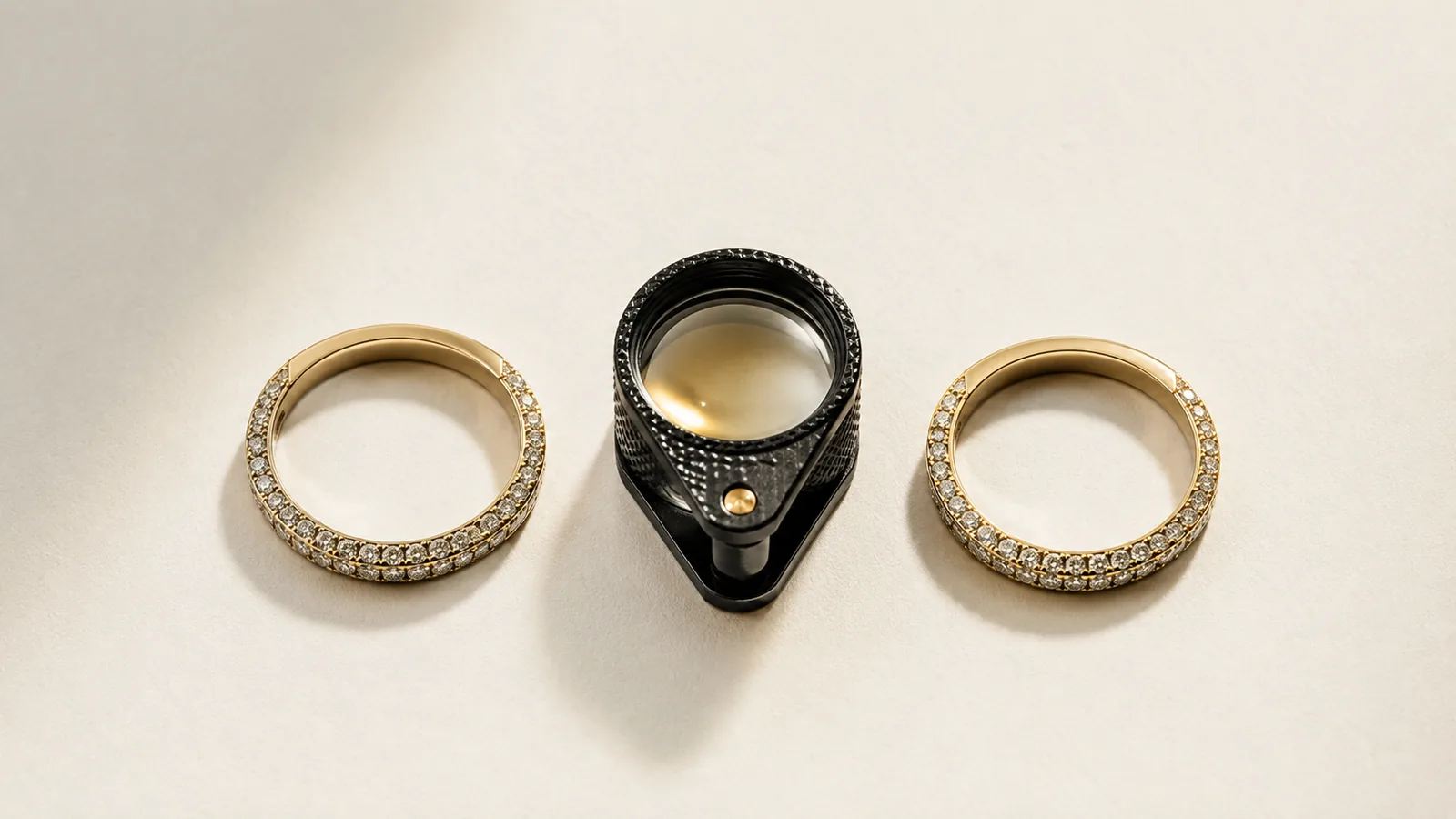
Two gold pave-set diamond bands lying either side of a jeweller's loupe

1. What to test in a demo

Rendering

Look at a pavé band and a coloured stone

Anyone can make a single round solitaire look acceptable. Melee stones in a halo or a pavé band are where cheap rendering shows — they smear into a grey ridge, or every stone lights identically because they are one mesh. Rotate slowly and watch whether individual stones catch light independently. Then switch to a step cut: an emerald that sparkles like a brilliant means the engine is not modelling the cut.

Mobile

Do the whole flow on a phone, on cellular

Most bridal traffic is mobile. Test time to first interaction, whether the option panel is usable one-handed, and whether switching setting five times leaves the page sluggish. Ask what actually downloads when a shopper changes metal — if it is a new model file rather than a shader parameter, every colour swap costs a round trip.

Combinatorics

Try to break the option matrix

Pick the least common shape and walk every setting. If the vendor multiplies shapes by settings without a compatibility map you will find assemblies that render wrong — a marquise floating above a basket built for a round. Then check the reverse: are options you cannot sell simply hidden, or greyed out and clickable?

Pricing

Ask how percentages compound

If a metal is +10% and a setting is +10%, is the answer +20% of base or +21%? Both are defensible; only one matches what a merchant means when they type it. Ask the question — the answer tells you whether anyone has thought carefully about the pricing model. Then ask what happens if two options are added in a different order.

2. Questions vendors do not volunteer

"Can the cart price be edited in a browser?"

If the configurator posts its computed total to the cart, yes. The safe pattern is that the browser sends selections and the server computes money — a Shopify Function, or a server-side pricing endpoint on other platforms. Ask which one, specifically.

"Which of these features is live today?"

Ask for a live URL for each one that matters to you — diamond feeds especially. Roadmap items are legitimate; roadmap items presented as shipped are what turns a launch date into a professional-services quote. Ring Facet's own answer is on the diamond feeds page.

"Can I use my own CAD?"

And if so: does it require re-exporting with particular layer names, is there a per-model setup fee, and does an unfamiliar stone cut render correctly without bespoke work? Our answer.

"What happens when a customer opens an old link?"

Saved builds outlive catalogue changes. If a link naming a discontinued setting shows an error or an empty step, expect support tickets from your most engaged customers.

"Does it survive a theme update?"

Anything that requires forking your theme becomes your maintenance problem at the next platform release. App blocks and iframes do not.

"What does my bench receive?"

Someone has to make the ring. Check that every selection reaches the order in text a person can read without opening a 3D viewer.
A brass jeweller's loupe standing upright, its lens catching a flash of spectral colour

3. The launch checklist

Placement

Decide where the builder lives before you install it

A dedicated design-your-ring page ranks and converts differently from a builder embedded in every product page. Most stores want both: a landing page for paid and organic traffic, and an entry point from the collection a customer is already browsing.

Catalogue

Turn off what you cannot make

The instinct is to enable everything. Resist it. Every option you cannot deliver at your quoted lead time becomes a support conversation and a refund.

Pricing

Reconcile the configurator against a real quote

Configure five rings across your range and price them the way you price them today. Differences are almost always a missing add-on rule, and they are far cheaper to find now than in a cart.

Operations

Run one real order end to end

Configure, add to cart, check out, and look at what arrives in your admin and your inbox. Then hand it to whoever makes the ring and ask whether they could work from it.

Staff

Put it on a tablet at the counter

The highest-value use of a configurator in the first month is usually in-store, not online. Staff who use it daily will also find your catalogue gaps faster than any QA pass.

Terminology

Not sure what a shank, a girdle, or a roleMap is?

The glossary covers the jewellery terms and the 3D commerce terms in one place, which is useful when a vendor call has both a bench jeweller and a developer on it.