Glossary for ring configurators.
Jewellery terms and 3D commerce terms in one list, because a configurator project usually has a bench jeweller and a developer on the same call using different vocabularies for the same object.
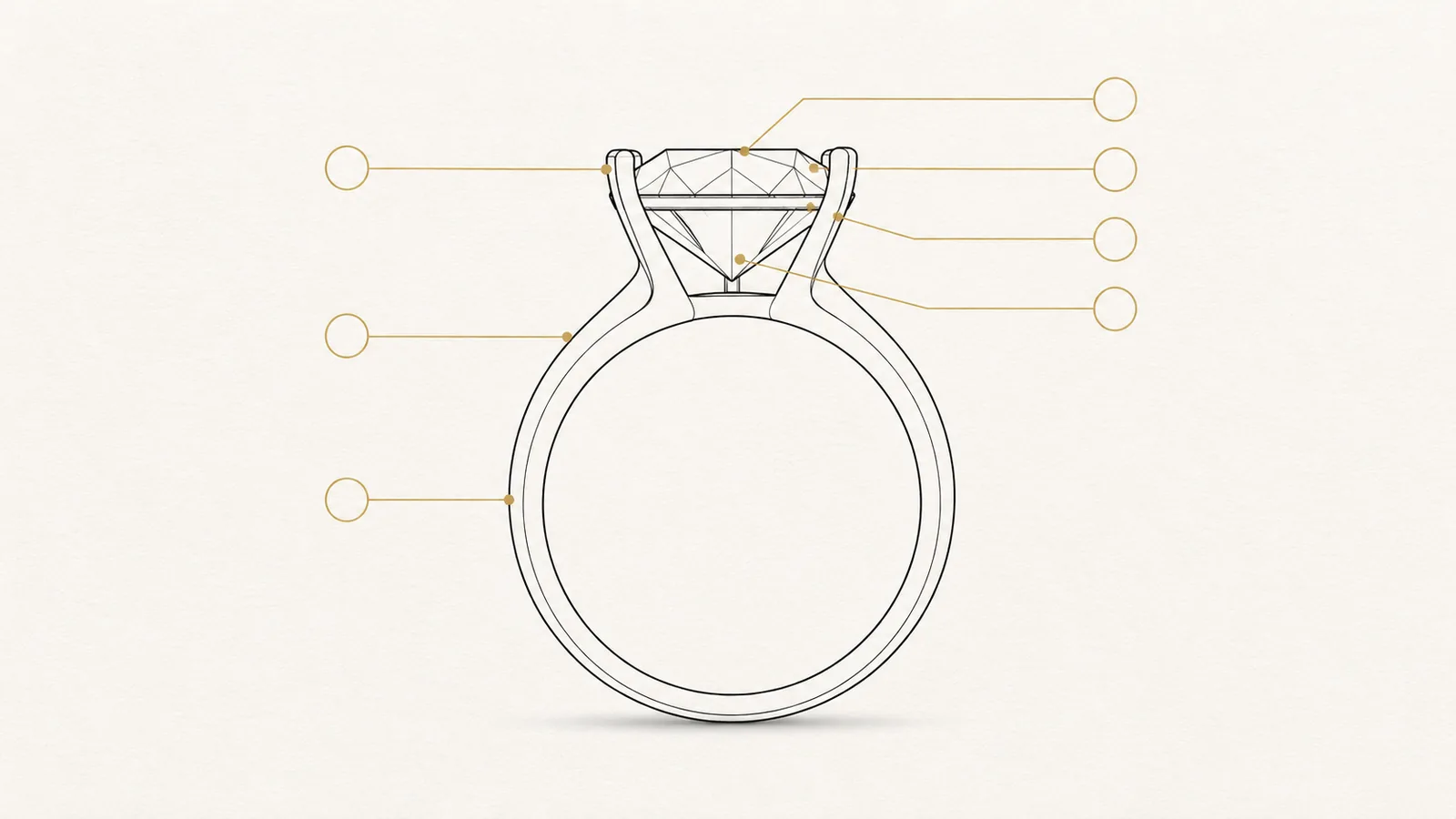 Prong
Shoulder
Shank
Table
Crown
Girdle
Pavilion
Prong
Shoulder
Shank
Table
Crown
Girdle
Pavilion
Left, top to bottom: prong, shoulder, shank. Right, top to bottom: table, crown, girdle, pavilion.
Ring anatomy
Head (setting)
The upper part of the ring that holds the centre stone. In a configurator the head is a separate model from the band, which is what lets any allowed head and band pair without pre-rendering every combination.
Shank (band)
The circular part that goes around the finger. Profiles include plain, side stone, twist, and diamond-set.
Prong (claw)
A metal finger that grips the stone. Four-prong shows more of the stone; six-prong holds it more securely. Prong height and angle are a real geometry problem, not a texture — a prong that sits too proud or sinks into the stone is visible immediately in 3D.
Basket
The cage of metal beneath the centre stone that the prongs rise from. A classic basket is open; a tulip basket flares outward like the flower.
Bezel
A continuous rim of metal around the stone instead of prongs. Protective and modern, and it changes how much light enters the stone from the side.
Halo
A ring of small stones surrounding the centre stone, making it read larger. A hidden halo sits below the centre stone facing outward, visible from the side rather than from above.
Pavé
Small stones set close together so the metal barely shows — literally "paved". The hardest thing for a web renderer to do convincingly, because exporters merge every stone into one mesh.
Melee
The small accent diamonds used in pavé, halos, and side stones, typically under 0.2ct each.
Solitaire
A single centre stone with no accent stones.
Three-stone / trilogy
A centre stone flanked by two others, conventionally read as past, present, and future.
Baguette
A rectangular step-cut stone. Tapered baguettes narrow toward one end and are used as side stones.
Cathedral
A shank that sweeps upward to meet the head like an arch, supporting the setting and raising the stone.
Diamond and stone terms
Table
The large flat facet on the top of the stone. The first surface most light enters through.
Crown, girdle, pavilion, culet
Top section, the widest edge, the lower cone, and the point at the bottom. Pavilion depth is what makes a stone bright or flat: a shallow pavilion leaks light and reads dull no matter how good the renderer is.
Brilliant cut vs step cut
Brilliant cuts (round, oval, pear, cushion) use triangular and kite facets for maximum sparkle. Step cuts (emerald, baguette) use long parallel facets for a hall-of-mirrors effect. A configurator that renders an emerald with brilliant-style fire is not modelling the cut.
The four Cs
Carat, colour, clarity, and cut. Ring Facet prices colour D–M and clarity FL–I3 individually, using the GIA scales.
Total internal reflection
Why a diamond looks like a diamond: light entering the table bounces between pavilion facets rather than passing through, and exits the crown split into colour. Reproducing it requires tracing rays against facets, which is why an environment map alone never looks right.
Dispersion (fire)
The splitting of white light into spectral colour as it passes through the stone. The coloured flashes, as distinct from white sparkle.
3D and commerce terms
GLB / glTF
The standard delivery format for 3D on the web. GLB is the single-file binary form and is what a configurator ships.
3DM
Rhino's native CAD format, and what most jewellery CAD work is authored in. It is a manufacturing format, not a web format, so it is converted to GLB for the storefront.
Draco
Geometry compression for glTF. It is the difference between a ring model being a few hundred kilobytes and a few megabytes.
PBR
Physically based rendering — materials described by properties like roughness and metalness rather than hand-painted highlights. It is why one gold material behaves correctly under any lighting.
HDRI / image-based lighting
A high-dynamic-range photograph of an environment used as the light source. Metal and gemstones want different environments: soft and broad for a polished shank, high-contrast for gem fire.
BVH
Bounding volume hierarchy — a spatial index that makes ray-tracing against a triangle mesh fast enough to be interactive. Ring Facet uses it as the fallback for stones too non-convex to trace analytically.
Tone mapping
Compressing high-dynamic-range colour into what a screen can display. Without it, a bright facet clips to a flat white blob instead of reading as a spark.
Line item property
Text attached to a cart line. How a configured ring's selections travel from the storefront to the order your bench works from.
Theme app block
A Shopify block a merchant can drop into a theme section from the editor, without editing Liquid. It survives theme updates; a theme fork does not.
Cart transform function
Shopify code that runs inside Shopify to change a cart line's price. The only way to guarantee a configured ring is charged what it was quoted, since a browser-supplied total can be edited.
Metafield
Structured data stored on a Shopify resource. Ring Facet writes pricing rules into one so the cart function can price a ring without calling out to another service.
Diamond feed
A supplier's live stone inventory, exposing shape, carat, colour, clarity, price, certificate, and availability. Where Ring Facet stands on feeds.
Terms are easier with the object in front of you.
Most of this glossary is visible in ten seconds of rotating a ring.