8 diamond shapes
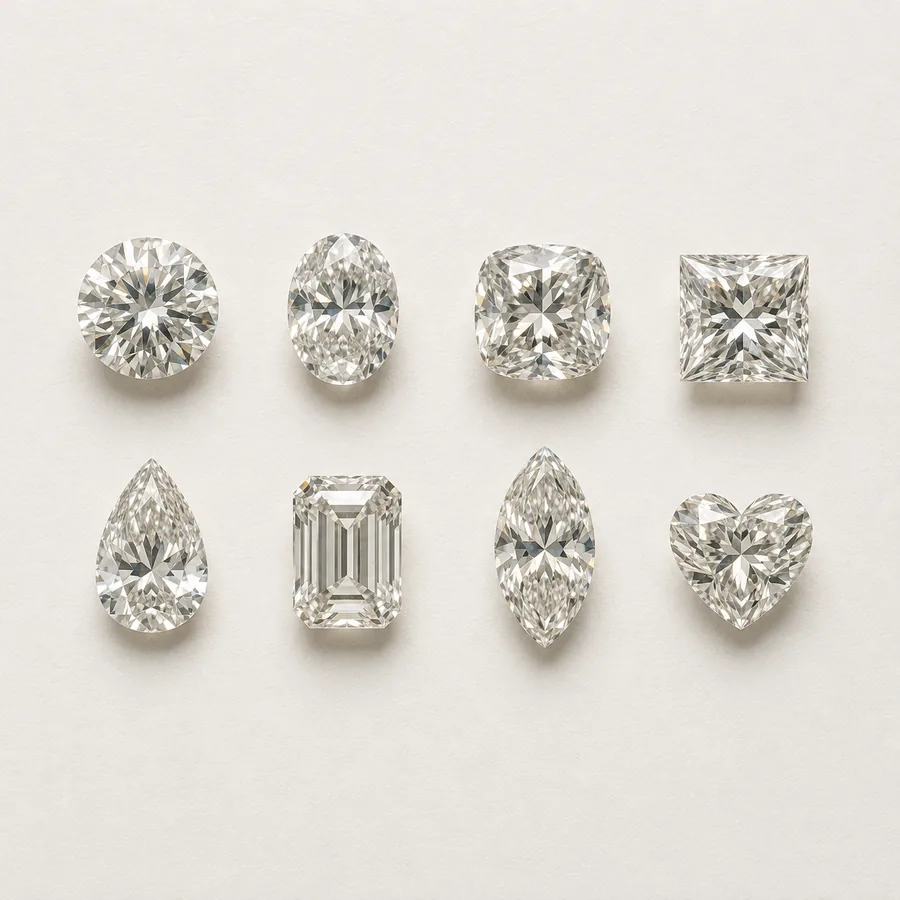
Round, Oval, Cushion, Princess, Pear, Emerald, Marquise, and Heart. Each shape carries its own centre-stone geometry, not a scaled copy of one stone.
A complete, checkable list of what a shopper can configure, what a merchant controls, and where a finished build goes. Nothing on this page is a roadmap item — features that are still coming are marked as such on the diamond feeds page.

Round, Oval, Cushion, Princess, Pear, Emerald, Marquise, and Heart. Each shape carries its own centre-stone geometry, not a scaled copy of one stone.
Solitaire — 4 Prong, Classic Basket, Tulip Basket. Halo — Pavé Halo, Hidden Halo, Bezel Hidden Halo, Floral Halo. Signature — Marquise Cascade, Three-Stone Pear, Three-Stone Oval/Pear, Three-Stone Basket, Tapered Baguette, Trilogy Halo.
Plain, Side Stone, Twist, Diamond, and Plain Twist. Bands are separate models from the head, so any allowed head and band pair is a real assembly rather than a pre-rendered photograph.
Not every shape carries every setting — Marquise has seven, Round has all thirteen — so the builder ships a compatibility map rather than an option grid that produces broken assemblies. Across the eight shapes that is 75 shape-and-setting pairs, times five bands, minus the two pairings the Bezel Hidden Halo cannot physically take. Multiply that by metal, karat, finish, carat, colour, clarity, ring size, and engraving and a 39-file catalogue merchandises a range no photo studio can shoot.
Every ring here is the same catalogue answering a different set of choices — head, band, centre stone and metal swapped independently. None of it is separate product photography, which is why a shape you stock in one metal costs nothing to show in four.
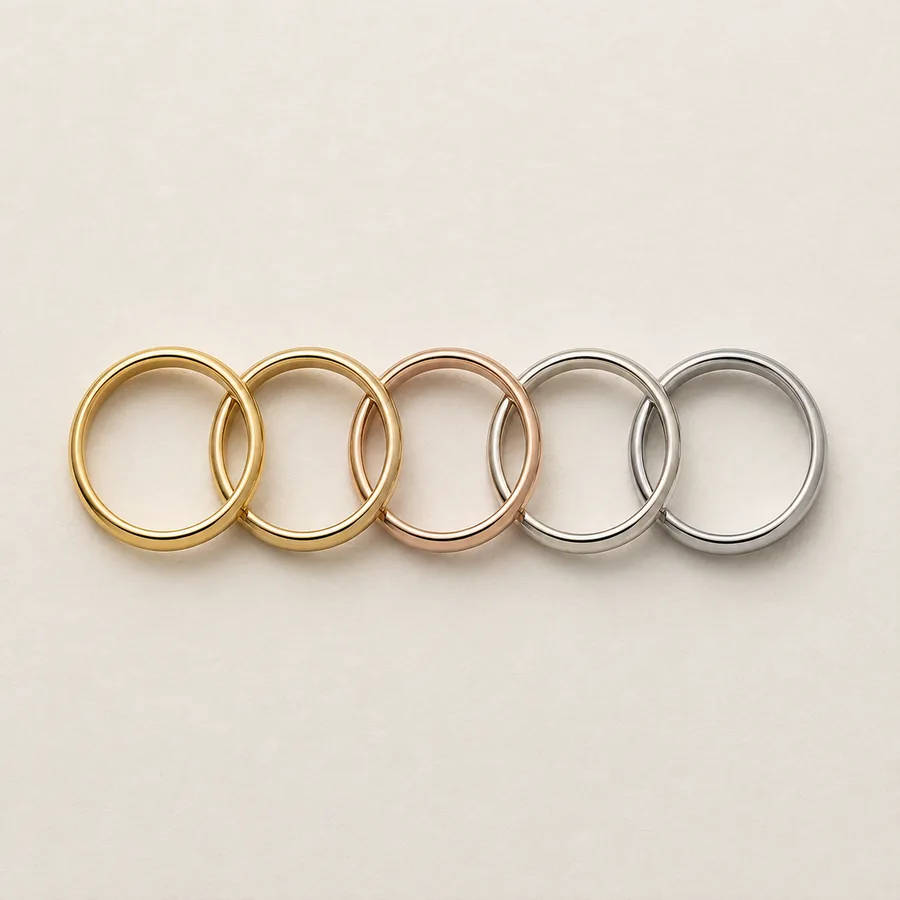
Yellow gold (24kt, 22kt, 18kt, 14kt, 9kt, 8kt), rose gold (22kt, 18kt, 14kt, 9kt, 8kt), white gold (18kt, 14kt, 9kt), platinum 950, and sterling silver 925. Colour is interpolated between karat stops rather than snapped to three flat swatches, so a 14kt yellow reads warmer than an 18kt white on the same model.
Finish is a real surface-roughness change in the renderer, not an overlay texture. The same ring under the same lighting reflects differently in each of the three.
Colour D through M and clarity FL, IF, VVS1, VVS2, VS1, VS2, SI1, SI2, I1, I2, I3 — the GIA scales, priced individually. Carat weight steps in half-carat increments from a merchant-defined included weight. Settings with fixed diamonds (the Signature family) skip the centre-stone step entirely rather than offering a choice that does not apply.
Eight presets — white diamond, sapphire blue, ruby red, emerald green, amethyst purple, champagne, morganite pink, citrine yellow — plus any RGB hex a merchant defines, each with its own price. The colour drives the stone's refracted output in the shader, so a sapphire disperses like a sapphire instead of showing as a tinted decal.
US/Canada 3 to 13 in half sizes (21), UK/AU F to Z½ (42), and European millimetre sizes 41 to 68 (28). A merchant publishes the system their market uses and can price larger sizes differently. Ring size is required before a quote request can be sent.
Script, Serif, Sans, Roman, and Handwritten, with a live preview of the inscription as it will be cut, a character counter, and a merchant-set maximum of up to 50 characters. Optional per embed, and carried through to the cart and the order as a visible line property.
Every option — metal, karat, size, carat, colour, clarity, setting, band, gem colour, engraving — carries its own add-on, in one of three modes: a fixed amount, a percentage, or an amount per carat. Percentages target either the base price or the subtotal, and a percentage never compounds on another percentage, so two +10% options add 20%, not 21%.
Nine rounding rules finish the number: none, nearest $1, $5, $10, $25, $50, $100, or always ending in 95 or 99. Display currency is any ISO-4217 code.
Turn off any shape, setting, or band you do not sell and it disappears from the shopper's flow — no greyed-out options, no dead ends. Set the default shape, setting, band, metal, and finish a shopper lands on. The builder repairs itself when a saved link names a combination you have since removed, rather than rendering an empty step.
Set an accent colour and the builder recolours its selected states, pills, and primary button. Text contrast against that colour is computed automatically, so a dark brand hue keeps white type and a pale gold keeps black. Full-width or contained layout. The Ring Facet mark can be removed on Scale.
An embed runs only on the domain you register for it. Hostnames are normalised — www.store.com and store.com are the same store — and the configurator additionally declares which sites are allowed to frame it, which is enforced by the browser rather than by page script.
Every configuration serialises into a URL. A shopper can send it to a partner, a salesperson can send it home after an appointment, and reopening it restores the exact ring — including engraving text and typeface.
Where a store sells by consultation, the builder captures the request and emails the merchant an itemised breakdown of every selection with the ring size attached, instead of a screenshot and a phone call.
On Shopify and WooCommerce the build adds to the native cart with every selection as a readable line property, and the final price is recomputed server-side so the browser can never set what the card is charged.
One line of HTML. Shopify, WooCommerce, Wix, Squarespace, BigCommerce, custom and headless builds — the configurator is not a theme dependency, so it does not break when a theme updates.
Drag the block into a theme section, and cart pricing is enforced by a Shopify Function. See the Shopify path →
The same embed, on a tablet at the counter. Save the build, send the link, skip the CAD-by-email loop.
Upload your own heads, bands, and stones and price them per part. See custom CAD →
The demo is the same build merchants ship. Nothing on it is a mockup.